Wiboonatthapol's bent-toed gecko
Cyrtodactylus wiboonatthapoli
Montri Sumontha, Nonn Panitvong, Kirati Kunya, Nattasuda Donbundit, Winai Suthanthangjai, Maneerat Suthanthangjai, Eakarit Phanamphon, Olivier S. G. Pauwels, 2024
Cyrtodactylus wiboonatthapoli, commonly known as Wiboonatthapol's Bent-toed Gecko, is a species of gecko in the family Gekkonidae. It is endemic to northeastern Thailand, where it is currently known only from a limestone cave system in Loei Province. The species was formally described in 2024 after being recognized as distinct from the superficially similar Cyrtodactylus papilionoides.
Taxonomy
The species was described in 2024 by Montri Sumontha, Nonn Panitvong, Kirati Kunya, Nattasuda Donbundit, Winai Suthanthangjai, Maneerat Suthanthangjai, Eakarit Phanamphon, and Olivier S. G. Pauwels.
The specific epithet wiboonatthapoli honors Wiboonatthapol for his contributions to Thai herpetology. The species belongs to the genus Cyrtodactylus, the largest genus of geckos, comprising numerous species distributed throughout Asia.
Distribution
Cyrtodactylus wiboonatthapoli is currently known only from Phu Pha Sana, including Erawan Cave, in Erawan District, Loei Province, northeastern Thailand. Despite surveys of nearby areas, no confirmed records outside the type locality have been reported.
The authors noted that previous reports of C. papilionoides from Loei Province may represent C. wiboonatthapoli, but this has not yet been confirmed.
Habitat
The species inhabits limestone karst and was observed near the entrance of a limestone cave. It is considered a cave-associated (trogloxene) species, utilizing cave habitats but not being restricted entirely to life underground.
Individuals were found on limestone surfaces close to the cave entrance, while additional reptiles and amphibians were observed in the surrounding karst environment.
Description
Cyrtodactylus wiboonatthapoli is a medium-sized bent-toed gecko characterized by a slender body and relatively long tail. It possesses the morphological features typical of limestone-dwelling Cyrtodactylus.
In life, the head is dark brown with darker reticulations. A blackish-brown nuchal loop connects the eyes and extends toward the shoulders. The dorsum bears three distinctive butterfly-shaped dark blotches separated by lighter interspaces with irregular brown markings. The tail is light brown with eleven dark rings, while the iris is greyish-golden. The throat and belly are light grey.
The species is distinguished from closely related species by a unique combination of scale counts, pore arrangement, body proportions, and colour pattern.
Ecology
Cyrtodactylus wiboonatthapoli is nocturnal and was encountered active on limestone surfaces near cave entrances.
At the type locality it occurs in sympatry with other gecko species, including Cyrtodactylus cf. interdigitalis, Gehyra cf. fehlmanni, and Gekko gecko, as well as several other reptiles and amphibians inhabiting the surrounding karst forest.
Conservation
The species is currently known from a single limestone hill and is therefore considered micro-endemic. Although no formal conservation assessment had been published at the time of its description, its apparently restricted distribution suggests that habitat disturbance affecting the limestone karst could pose a risk to the species. The original description did not propose an International Union for Conservation of Nature conservation status.
This article uses material from Wikipedia released under the Creative Commons Attribution-Share-Alike Licence 3.0. Eventual photos shown in this page may or may not be from Wikipedia, please see the license details for photos in photo by-lines.
Scientific classification
- Kingdom
- Animalia
- Phylum
- Chordata
- Class
- Reptilia
- Order
- Squamata
- Suborder
- Lacertilia
- Family
- Gekkonidae
- Genus
- Cyrtodactylus
- Species
- Cyrtodactylus wiboonatthapoli
Common names
- English:
- Wiboonatthapol's bent-toed gecko
- Wiboonatthapol's Cave bent-toed gecko
Photos

Range Map
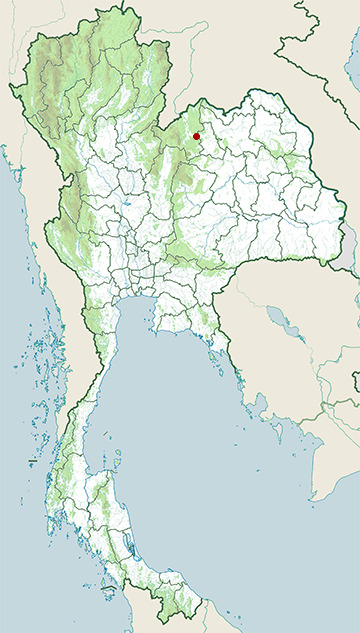
- Erawan District, Loei
Please help us review our species pages if wrong photos are used or any other details in the page is wrong. We can be reached via our contact us page.