About Doi Inthanon
Doi Inthanon is one of the most popular national parks in Thailand. The park is known for its waterfalls, nature trails, remote villages, viewpoints, sunrise and sunset spots, birdwatching opportunities, and cool weather at higher elevations throughout the year. The main entrance is around 70 km southwest of Chiang Mai city center.
Also known as the “Roof of Thailand”, Doi Inthanon National Park covers 482 km² in Chiang Mai Province in northern Thailand. The park is part of the Himalayan mountain range, with elevations ranging from 800 to 2,565 meters above sea level. Doi Inthanon, the park’s highest peak, is also the highest mountain in Thailand. Due to its elevation, the park experiences high humidity and relatively cool temperatures year round.
The park was named in honour of King Inthawichayanon, one of the last rulers of Chiang Mai, who was concerned about deforestation in northern Thailand and wanted the forests preserved. Following his death, his remains were placed in the park according to his wishes, and the mountain was renamed Doi Inthanon in his honour.
The park’s vegetation includes moist evergreen cloud forests and sphagnum bogs above 1,800 meters, as well as dry evergreen, pine, mixed deciduous teak, and dipterocarp forests at lower elevations.
The rainy season lasts from May to October, with the heaviest rainfall typically occurring between July and September. The remainder of the year is comparatively dry, with cooler weather from November to February.
Wildlife
Due to historical poaching and habitat changes, many large mammals such as elephants, tigers, and gaurs disappeared from the park decades ago. However, species such as wild boars, gibbons, deer, and Chinese gorals still inhabit the area. Around 65 mammal species have been recorded in the park, nearly half of them bat species. Lucky visitors may occasionally spot Chinese gorals along the Kew Mae Pan Nature Trail, although sightings are rare.
With around 500–510 recorded bird species, Doi Inthanon has the highest bird diversity of any national park in Thailand. Some bird species recorded in Thailand only from Doi Inthanon include the ashy-throated leaf warblers, dark-breasted rosefinches and collared grosbeaks. Several other species are found only in Doi Inthanon and adjacent parks.
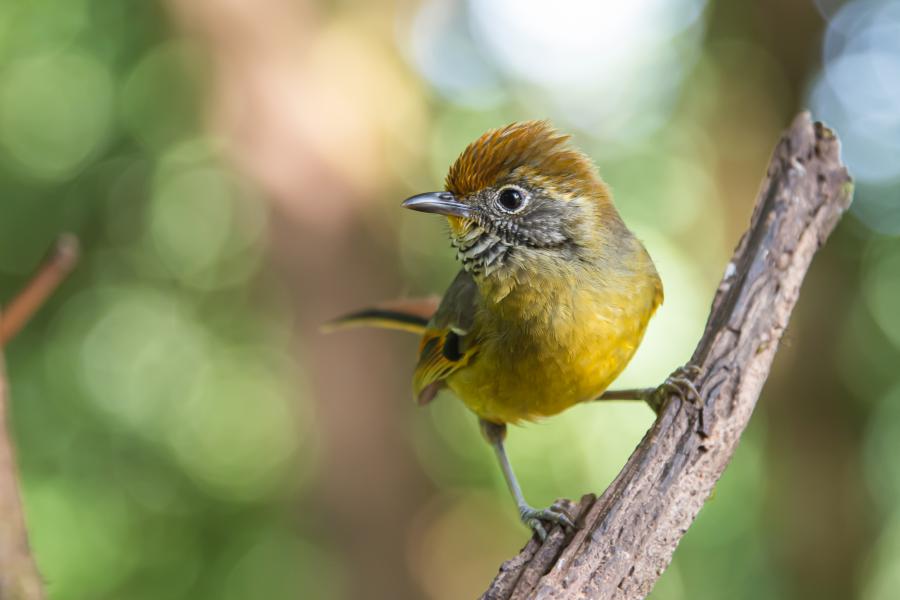
Bird migration activity increases around March and continues through the breeding season until June or July, making this one of the best periods for birdwatching.
Around 50 reptile species have currently been recorded in the park, though the actual number is likely higher.
Three pit viper species found in the park are Lanna pit vipers (Trimeresurus popeiorum), Guo's green pit vipers (subspecies of Trimeresurus albolabris) and Himalayan mountain pit vipers (Ovophis monticola). Other notable snakes recorded here include the two-striped keelbacks (Hebius bitaeniatus) and Namdong wolf snakes (Lycodon chapaensis).
The Chiang Mai dwarf gecko (Hemiphyllodactylus chiangmaiensis) is an endemic species currently known only from Doi Inthanon National Park. Other rare lizards recorded from the park include the Doi Inthanon bent-toed geckos (Cyrtodactylus inthanon), Doria's leaf-litter skinks (Scincella doriae), Yunnan dwarf geckos (Hemiphyllodactylus yunnanensis).
Tortoise and turtle species recorded from the park include the Elongated tortoises (Indotestudo elongata), impressed tortoises (Manouria impressa) and big-headed turtles (Platysternon megacephalum).
Around 30 amphibian species are known from Doi Inthanon, including the Chiang Mai newt (Tylototriton uyenoi). Inthanon horned toad (Megophrys angka), Anderson's odorous frog (Odorrana andersonii), Doi Inthanon torrent frog (Amolops archotaphus), Schmacker's odorous frog (Odorrana schmackeri), white-eyed litter frog (Leptobrachium huashen) and Inthanon stream toad (Ansonia inthanon), several of which are endemic to the mountain range.
Getting there & getting around
Getting to the park
The only public transportation option is the local songthaew system, consisting of shared passenger vehicles adapted from pickup trucks. Reaching the park by public transport can be challenging, as transfers between multiple songthaews are often necessary. Depending on connections, the journey from Chiang Mai may take at least 2.5–3 hours.
Once inside the park, distances between attractions are considerable, making walking between them impractical unless prepared for long roadside walks.
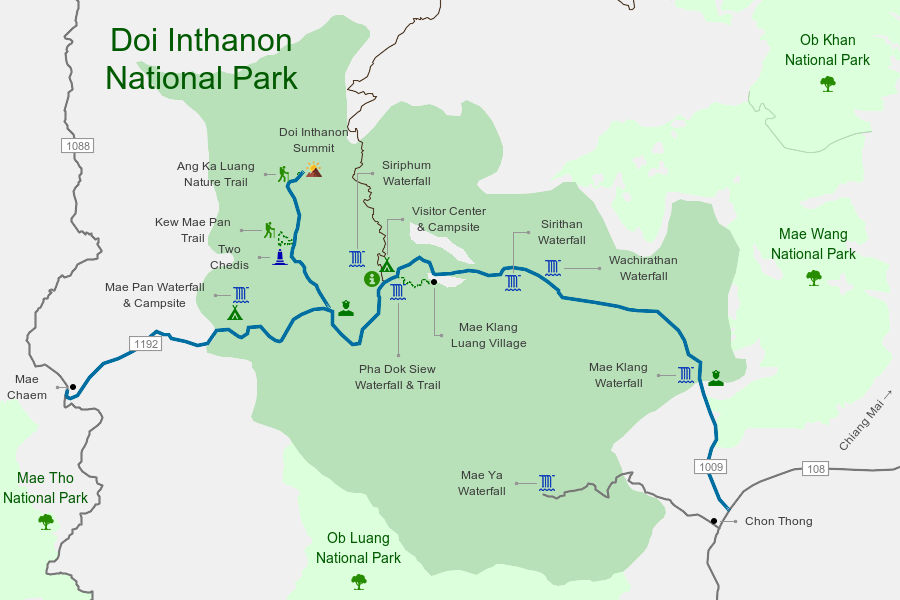
The main entrance checkpoint is located at km 8 on Rural Road 1009, accessible from Highway 108 southwest of Chiang Mai. The visitor center and park headquarters are located another 22 km inside the park.
See the “Get There & Stay” section for more detailed transport information.
Getting around inside the park
Because of the large distances between attractions, visitors are strongly advised to use a car or motorbike. Walking between attractions along the main road is generally not practical.
The park can become extremely crowded during long holiday periods such as New Year and Songkran, when traffic jams may extend deep into the park. Weekends are generally busier than weekdays.
Tours & private transportation
Private tours and taxi services to Doi Inthanon can be arranged in advance.
- Private taxi | full-day service from 3,200 Baht
- Private guided day tour with an English-speaking guide
Private guided tours in Doi Inthanon National Park
Join a private guided tour to get to the highest point in Thailand, see waterfalls, hike.
More infoEntrance fees & opening times
As of June 2022, the entrance fees Doi Inthanon National Park are 300 Baht for adults and 150 Baht for children 3-14 years old. Thai citizens pay 60 Baht for adults and 30 Baht for children. Cars will be charged with 30 Baht and bikes with 20 Baht.
The park visitor center is open daily from 08:00 am to 16:00 throughout the year but most attractions can be visited from early morning, until around 4-5pm. The park’s most popular trail, Kew Mae Pan Nature Trail, is closed annually from June to October for forest recovery.
The Two Chedis and the Royal Agricultural Station Inthanon are two attractions within the national park that are not managed by the park authorities. Entrance fees for these attractions are 100 Baht and 20 Baht, respectively.
Activities
The headquarters area contains a large campsite located roughly in the center of the park. Sirithan Waterfall, the nearest attraction to the campsite, can be reached on foot.
The summit of Doi Inthanon is one of the park’s most visited areas due to its cool climate and scenic views. The viewpoint near the Kew Mae Pan trailhead is especially popular for sunrise viewing, while the nearby Two Chedis area is a favored sunset spot.
Several waterfalls are located along the road leading toward the headquarters area, most reachable with only short walks from the roadside. Water flow is generally good year round, especially during the rainy season from May to November. Most waterfalls are in rocky areas and are not ideal for swimming.
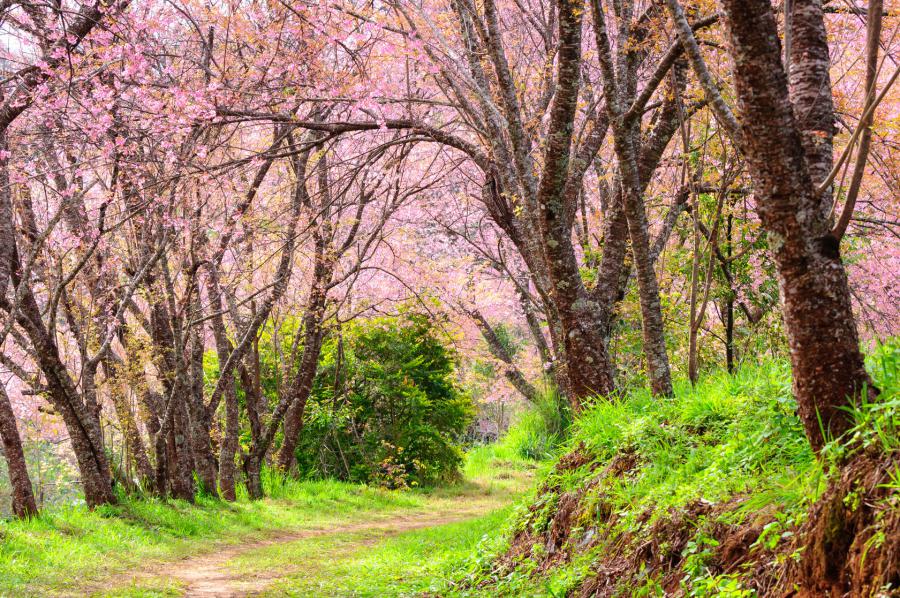
One of the park’s seasonal highlights is the blooming of Siamese sakura trees, which briefly cover parts of the park in pink flowers during late January and early February.
Birdwatching opportunities are good throughout the park, especially along the main road leading to the summit.
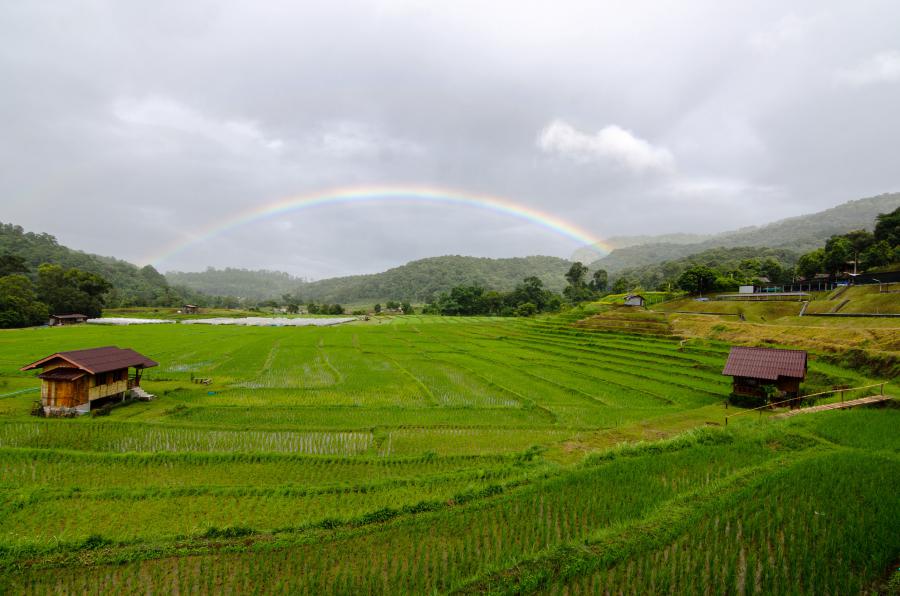
Mae Klang Luang Village, around 6 km east of the headquarters area, is known for its picturesque rice fields during the latter part of the rainy season. The village also has cafes and restaurants. Outside the rice-growing season, the fields are less scenic.
Stay & eat
The main campground and park accommodations are located around 500 meters north of the headquarters area.
Camping
There is a campsite less than a kilometer north of the park headquarters. The campsite is open during the cooler months from 1st October until 15th February and closed the rest of the year. The dates may vary from year to year.
The campsite is spacious, with camping fees of 30 Baht per person per night. Camping equipment can be rented near the campsite entrance. Small tents for up to three people cost 225 Baht per day, while sleeping bags, mats, and pillows cost an additional 60 Baht per person in total (prices as of May 2026).
There are no restaurants directly within the campsite area. The nearest food options are near the headquarters area and the Hmong Market further west.
Temperatures in the park are always cool at night. During winter, temperatures can occasionally drop close to freezing, so warm clothing is strongly recommended for campers.
Accomodations
Various park accommodations of different sizes are scattered around the camping area. Prices range from around 1,000 Baht to 6,500 Baht per night. A 30% discount applies for bookings from Monday to Thursday.
Accommodation bookings are managed by the Department of National Parks (DNP). While reservations are normally made through the DNP website, the online booking system has experienced prolonged outages and has been unavailable during the 2026 season. Visitors may need to arrange bookings directly with the park or DNP by telephone. English-language support may be limited. As of June 2026, the booking system is still down.
Eat
There are several restaurants and food stalls throughout the park, including at Kew Mae Pan Trail, the Two Chedis area, Hmong Market east of the headquarters, Wachirathan Waterfall, and a few other locations. There is also a café at the summit and at several additional viewpoints within the park.
Phone(s)
You are recommended to ask a Thai speaking person to call on your behalf.
- 053 286 729 (Visitor Center)
Attractions of Doi Inthanon
Doi Inthanon Summit
Located at km 48 at the end of the road 1009, with an altitude of 2,565 meters asl, it is the highest peak in Thailand.
If you are after a challenging hike up to the highest point in Thailand, forget about it. The summit is accessible by car or bike all the way up, but you could hike a few hundred meters from the parking area to the actual summit. There are no longer trails to hike to the summit.
The summit viewpoint is a popular place for watching the sunrise, but the view from the road near Kew Mae Pan Trail a bit further south is a better spot to target the sunrise. Summit area is risky to target the sunrise because it is too often misty. For sunset, please read Phra Mahathat Naphamethanidon and Naphamethanidon (Two Chedis) further below.
Ang Ka Luang Nature Trail is not too far down the road, see below for more info.
There is a cafe next to the summit trailhead. There are a couple of squirrel and bird species which get very near people while sitting and enjoying the view from this cafe.
Ang Ka Luang Nature Trail
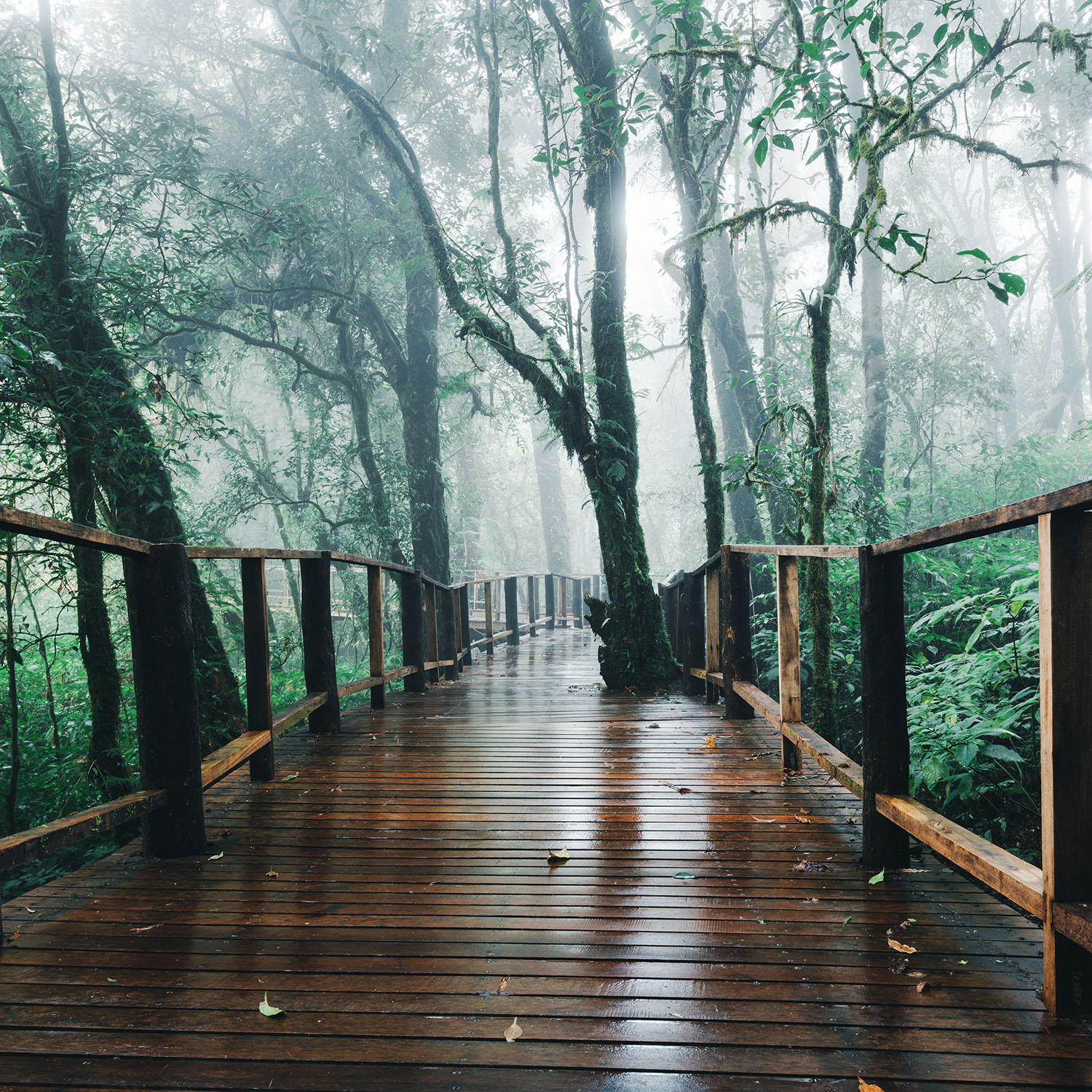
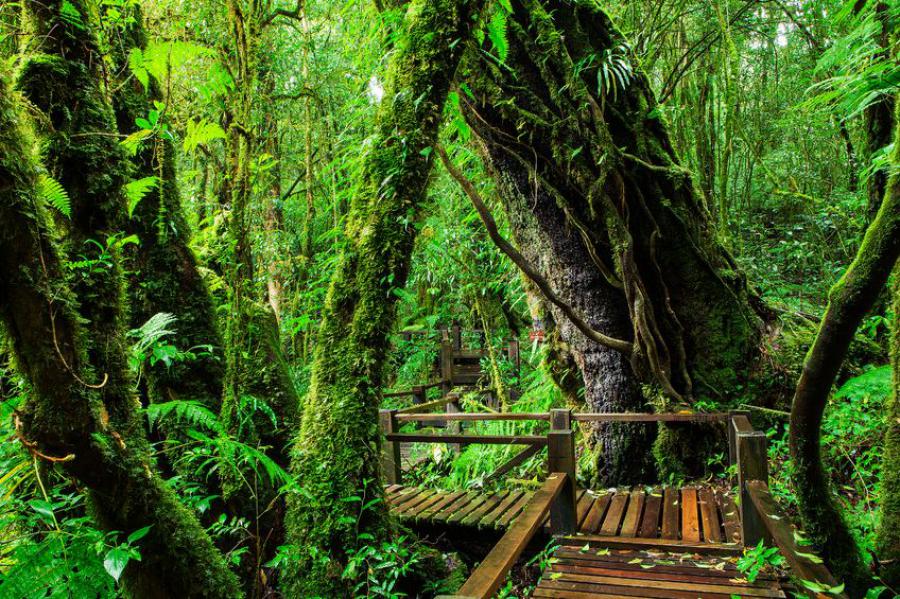
A shorter circular boardwalk nature trail slightly on the opposite side from the trail to the summit. The habitat around the boardwalk is magical, very dense, mossy, lush forest all year round. This trail is highly recommended.
Kew Mae Pan Nature Trail
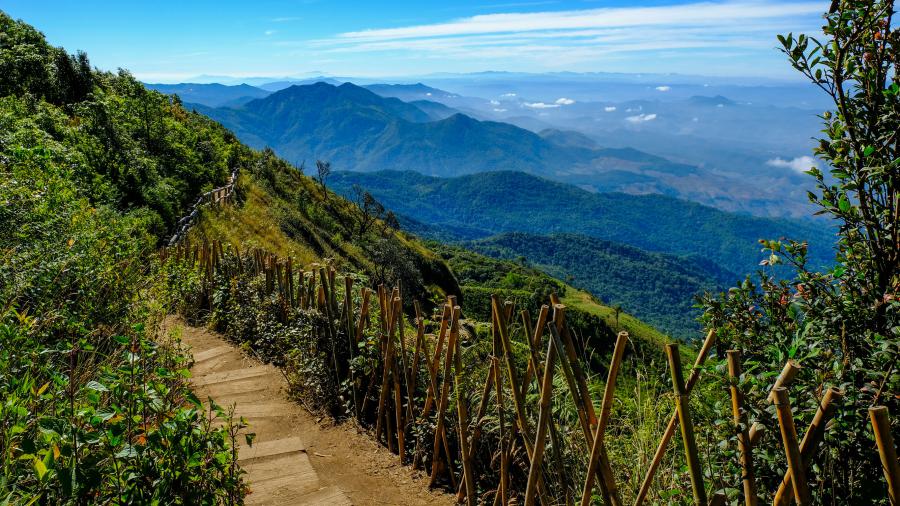
Starting from the main road just a few hundred meters north of the two chedis, this 2.5 km long circular trail must be accompanied by a Hmong Tribe guide. The hike is easy to moderate to walk, clear and well maintained. Part of the trail is along a mountain ridge with a beautiful view over west. The very rare Chinese gorals are relatively common along this trail but sighting is rare, a lot of attempts needed to eventually see one. It costs 220 Baht to hire a guide, there are always a few of them waiting at the trailhead on the main road and can only be hired on spot.
Many visitors think the viewpoint along the trail is ideal for watching the sunrise — but it’s not. That viewpoint faces west, not east. For sunrise, you actually need to go to the main road where the trail begins. There’s a proper viewpoint there next to the car park facing east.
Kew Mae Pan Nature Trail is closed from June to October every year, re-opens 1st November.
Two Chedis
Also known as Phra Mahathat Naphamethanidon and Nophamethanidon in Thai, Two Chedis are on the main road 5 km south from the top of the main summit of Doi Inthanon.
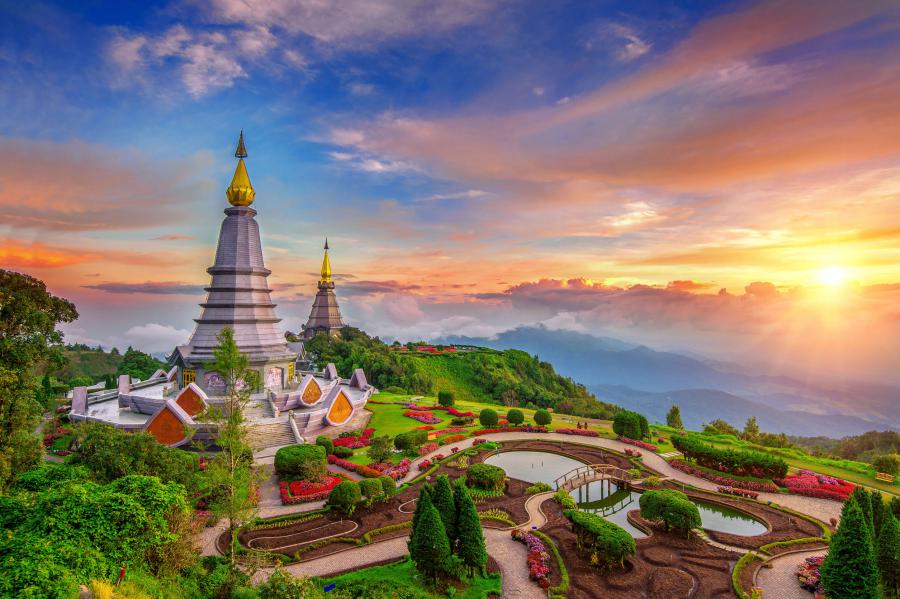
The first of the chedis, Naphamethinidon, meaning 'by the strength of the land and air' was built in 1987 to honour the 60th birthday anniversary of King Bhumibol Adulyadej. The second chedi, Naphaphone Phumi Siri, meaning 'being the strength of the air and the grace of the land' was built in 1992 to honour the 60th birthday anniversary of Queen Sirikit.
There is a viewpoint with a good view over the west side of the park, a popular place to see the sunset.
Two Chedis are not managed by park. The entrance os 100 Baht per person.
Waterfalls
Doi Inthanon National Park has many waterfalls, some easily accessible from the main road through the national park, only a few hundred meters off from the road. The waterflow is good all year round but most impressive during the rainy season from May to November. During the cold and dry seasons the water is more clear and more suitable for swimming if possible, but most waterfalls are very rocky, swimming possibilities are very limited.
Wachirathan Waterfall
One of the most impressive waterfalls in the park, the most popular one due to its location and easy access. As with most other waterfalls, the size of this waterfall is very exaggerated by park staff or guides, but still, with around 40 meters height and the impressive wide look, it is no doubt one of the best falls in the park.
There are a number of restaurants, cafes and shops around the car park area of the falls.
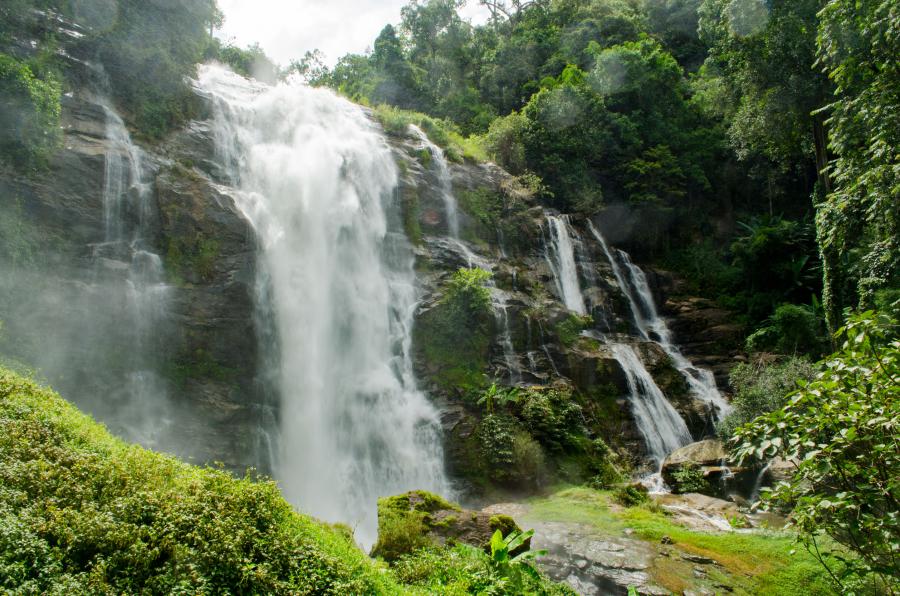
Sirithan Waterfall
One of the most popular waterfalls, at km 22, accessible by a 200 meters long trail from the parking area on the main road. This waterfall can only be seen from a viewpoint not too far from the falls. It is not possible to get all the way down to the waterfall.
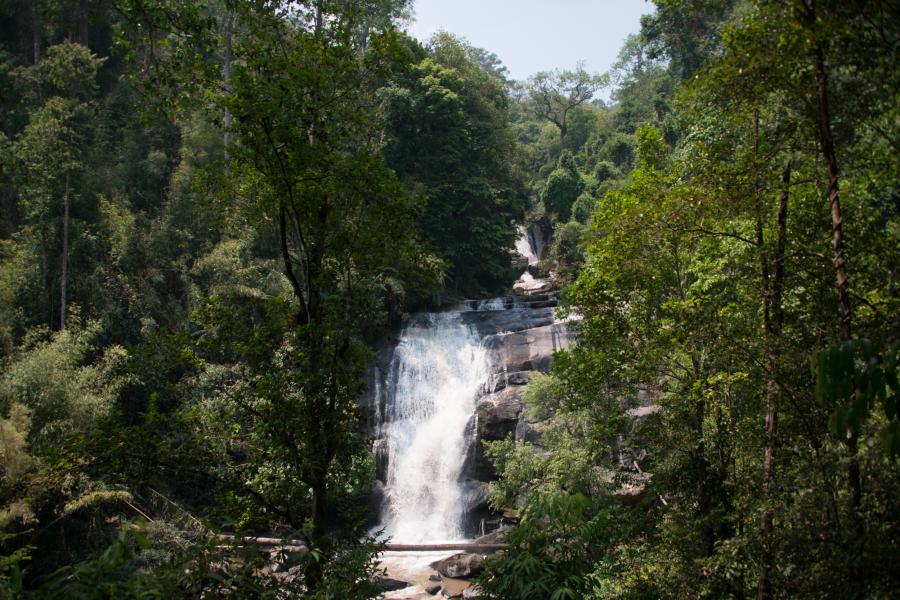
Siriphum Waterfall
1.5 km off the road 1284 north of headquarters, accessible by a trail on the west side of Ban Khun Klang village and the Royal Garden. The area around this waterfall gets sakura blooming in February.
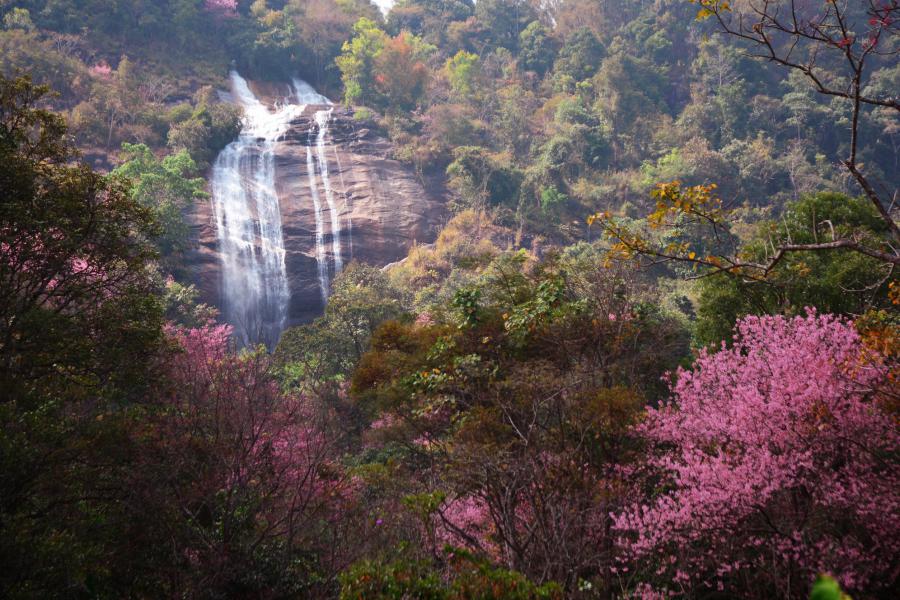
Pha Dok Siew Waterfall
A multi-tiered waterfall located half way through a 2.6 km long trail starting from the main road about a km east from headquarters and ends at a nearby Mae Klang Luang Village. The village has a picturesque view of rice fields on the hill slopes during the rainy season.
The trail must be accompanied by local guides waiting at the trail-head on the main road. The local guides charge 220 baht per group of max 10 people.
Mae Klang Waterfall
It is the first waterfall on the main road into the national park, cascading nearly 100 meters tall over several tiers with the tallest tier nearly 25-30 meters. It is located 600 meters south of the checkpoint at the southeast part of the park.
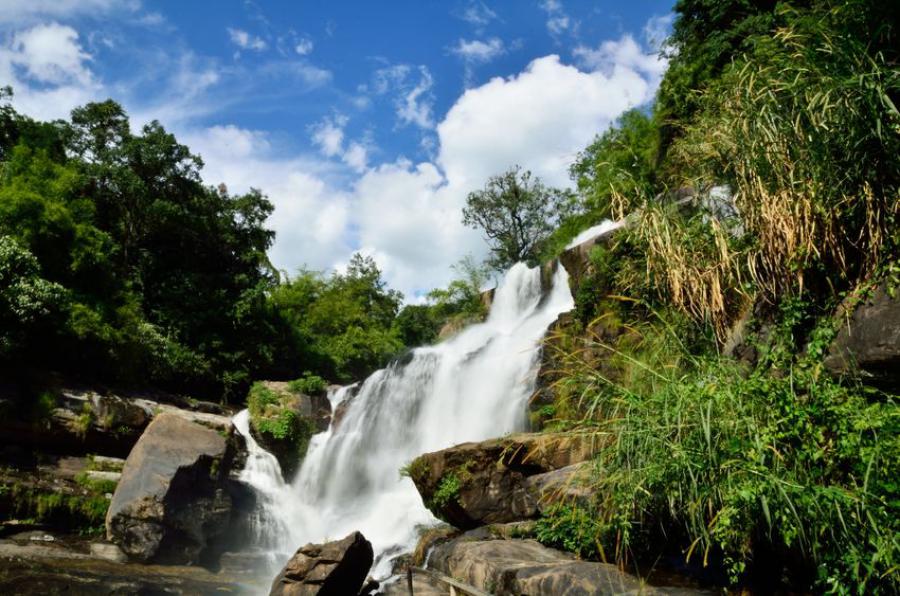
Mae Ya Waterfall
A cascading waterfall plunging from several tiers over 250 meters. The main accessible tier is 40 to 50 meters tall and around 100 meters wide, no doubt one of the most impressive falls in the country.
It is said to be the biggest waterfall in the country, but to be taken with a pinch of salt. The tallest single tier fall in Doi Inthanon National Park is Mae Pan, read further below, there are taller and much wider falls in the country.
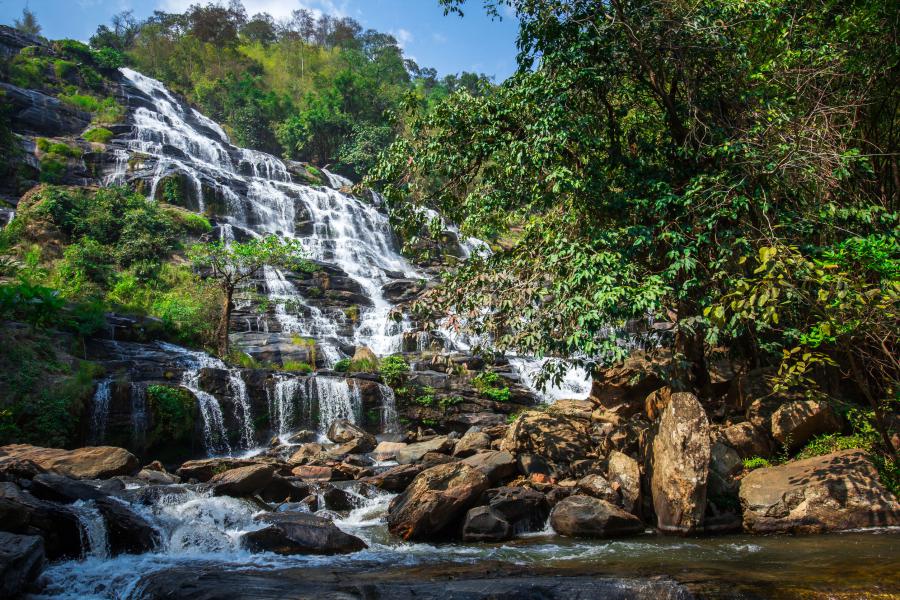
Mae Ya is located in the southern parts of the park, around 17 km southwest from the main checkpoint into the park. Mae Ya has its own checkpoint where the national park entrance fee must be paid for entry. Same entrance fee is valid for the entire national park.
Mae Pan Waterfall & campsite
Mae Pan is a 100 meters tall waterfall off from the other attractions of Doi Inthanon, situated at the end of a 2 km dirt road from Mae Chaem Road. It is the tallest non-cascading waterfall in the park, due to it's relatively remote location it is not visited much by the local tourists which prefers to stop by at first 4-5 waterfalls on the way to the HQ. The trail to the waterfall can be very slippery, but worth the effort to get there. Apart from the waterfall there is a shorter loop trail that can be hiked in less than 2 hours.
There is a campsite in Mae Pan area, but there are no tents available for rent and there are no restaurants nearby.
Royal Project Inthanon
Established in 1979, Royal Project Inthanon is a nearly 1 km² flower garden. The main purpose of starting this project was to eliminate opium growing by educating the locals. The garden is located at the Khun Klang Hhong village 1.5 north from the headquarters.
There are several greenhouses at the garden for growing Rhododendron flowers, ferns, Hydroponics vegetables and various other flowers.
Mae Klang Luang Village
A village around 5 km east of headquarters, right south of the main road. This village has rice fields nestled on mountain slopes, creating a very nice view during the rainy seasons. There are restaurants and cafes in the village.
Brichinda Cave
A 250 meters long limestone cave not too far away from the entrance of the park, accessible from km 9 (1 km north from checkpoint at km 8) with less than an hour of hiking from the main road. It has two chambers with a spacious one near the cave entrance.
The cave has been closed for the visitors since 2015 (confirmed Nov 2021 it is still closed). It isn’t even possible to get there with a ranger.